

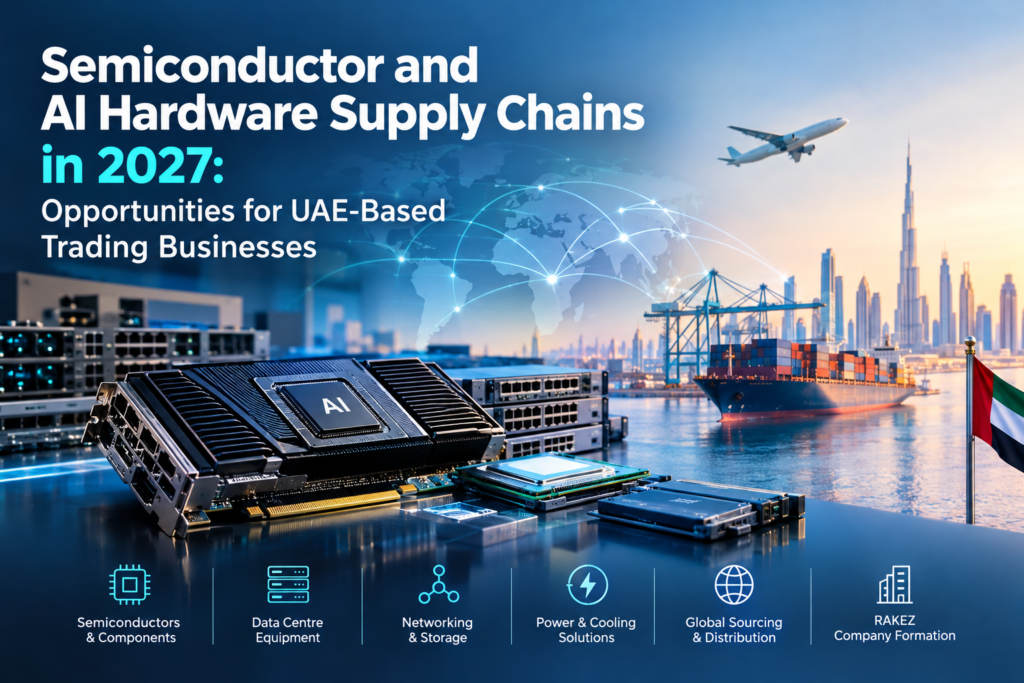
Artificial intelligence is changing the global electronics industry, creating demand for advanced semiconductors, high-performance computing systems, data-centre infrastructure, and specialised electronic components. As businesses invest in AI applications, cloud computing, and digital infrastructure, the supply chains supporting these technologies are becoming increasingly important.
For 2027, one of the key commercial questions is how businesses can source, distribute, and manage AI hardware amid changing technology requirements, supply constraints, and international trade regulations.
The World Trade Organization has identified strong demand for AI-related products, including semiconductors and data-centre equipment, as an important contributor to global merchandise trade growth. Its October 2026 outlook projected global merchandise trade growth of 4.1% in 2027, although economic and geopolitical risks remain.
Against this backdrop, the United Arab Emirates may offer opportunities for businesses involved in electronics trading, component sourcing, IT equipment distribution, and regional supply-chain management. For entrepreneurs exploring UAE business setup, a trading operation in Ras Al Khaimah Economic Zone (RAKEZ) could be worth evaluating, subject to the relevant licence, product requirements, and export-control rules.
Why Could Semiconductor and AI Hardware Demand Grow in 2027?
AI infrastructure depends on a much wider ecosystem than processors alone. A functioning AI data centre requires computing hardware, memory, networking, storage, power management, cooling, and supporting electrical systems.
Several developments could influence demand in 2027.
1. Expanding AI Data-Centre Infrastructure
AI models require substantial computing capacity for training, inference, and enterprise deployment. This creates demand for GPU-based servers, accelerators, high-speed networking equipment, and specialised storage systems.
Businesses supplying data-centre operators, system integrators, cloud service providers, and enterprise IT departments may find opportunities in hardware procurement and distribution.
However, demand does not guarantee profitability. Hardware prices, supplier allocation, product availability, warranty conditions, and rapid product obsolescence can all affect trading margins.
2. High-Bandwidth Memory and Advanced Components
AI accelerators depend on high-performance memory and advanced packaging technologies. These components can face different capacity constraints from conventional consumer electronics.
Distributors may therefore need to manage allocation agreements, verified sourcing, lead times, and compatibility requirements rather than relying solely on spot-market purchasing.
For businesses entering this sector, reliable access to genuine products and traceable suppliers may be more valuable than purchasing at the lowest advertised price.
3. Growth in Networking, Power and Cooling Equipment
AI computing infrastructure requires high-speed data transfer, stable electrical supply, thermal management, and supporting infrastructure.
This creates potential opportunities in adjacent product categories, including:
- Enterprise networking equipment and switches.
- Server racks, cables, and connectivity components.
- Power distribution units and selected power-management equipment.
- Cooling-system components and monitoring devices.
- Storage devices and enterprise IT accessories.
- Compatible replacement parts and maintenance supplies.
These categories can provide a broader entry point for trading businesses than focusing exclusively on advanced AI chips. Each product category still requires appropriate licensing, technical verification, and compliance checks.
Why Could the UAE Be Relevant to AI Hardware Distribution?
The UAE connects businesses across the Middle East, Africa, South Asia, and international trading markets. Its logistics infrastructure and established import-export ecosystem make it a location worth assessing for companies that want to coordinate regional hardware distribution.
RAKEZ has promoted opportunities for trading, electronics, manufacturing, and engineering businesses, including companies expanding their international operations.
For a hardware distributor, the potential value of a UAE base may include:
Regional customer access: Coordinating sales and procurement for customers across multiple markets.
Inventory management: Holding selected, fast-moving products closer to customers where appropriate facilities and customs arrangements permit.
Supplier coordination: Managing commercial relationships with manufacturers, authorised distributors, logistics providers, and regional resellers.
Business-to-business distribution: Supplying system integrators, IT service providers, data-centre contractors, and enterprise procurement teams.
These advantages depend on the actual business model. A UAE company does not automatically obtain preferential access to restricted chips or special distribution rights from manufacturers.
Semiconductor and AI Hardware Trading Opportunities in 2027
1. Enterprise Server and Networking Equipment
Companies deploying AI and cloud infrastructure need servers, network switches, storage systems, and associated components. A trading business may source eligible equipment from verified suppliers and distribute it to enterprise customers or systems integrators.
The commercial challenge is maintaining accurate product specifications, confirming compatibility, providing warranty documentation, and avoiding grey-market or counterfeit goods.
2. Industrial Electronics and Electronic Components
Not every semiconductor-related opportunity involves cutting-edge processors. Industrial control systems, embedded computing, communication equipment, sensors, and electronic spare parts also depend on semiconductor components.
Distributors serving industrial automation, telecommunications, and equipment-maintenance companies may be able to build recurring customer relationships around component availability and dependable delivery.
3. AI Infrastructure Accessories
Cables, racks, storage accessories, power equipment, and selected cooling components may serve customers building or maintaining AI infrastructure.
These products can involve different regulatory and capital requirements from advanced processors. Nevertheless, businesses must confirm product certifications, technical compatibility, transport requirements, and any applicable restrictions.
4. Procurement and Sourcing Services
Some businesses may prefer to operate as procurement coordinators rather than hold large inventories. Their services could include supplier identification, quotation management, order consolidation, logistics coordination, and documentation support.
A service-led model can reduce the amount of capital tied up in stock, although it still requires clear contractual responsibilities, supplier verification, and the correct business licence.
5. Refurbished and Replacement IT Equipment
There may also be demand for eligible refurbished servers, networking hardware, and replacement components. This segment requires particularly careful quality control.
Businesses should verify product ownership, serial numbers, refurbishment standards, data sanitisation where relevant, warranty terms, and applicable import or export restrictions. Some equipment may have limited resale value because of software support, security requirements, or compatibility issues.
Can RAKEZ Support a Semiconductor or AI Hardware Trading Business?
RAKEZ may be worth considering for entrepreneurs seeking to establish a UAE-based trading operation. The appropriate business structure depends on the exact products, sales channels, storage needs, and intended markets.
Before proceeding with RAKEZ company formation, businesses should clarify the following:
- Licence activity: Confirm that the selected commercial activities cover the intended semiconductor, electronic-component, server, or IT hardware transactions.
- Operating model: Determine whether the company will trade goods, provide sourcing services, maintain stock, or combine these activities.
- Facilities: Assess whether an office, warehouse, or specialist storage arrangement is necessary.
- Import and export procedures: Establish the documentation and customs arrangements required for each product and destination.
- Banking and payments: Prepare supplier contracts, invoices, ownership details, and transaction documentation for financial institutions and payment providers.
- Product compliance: Check certification, warranty, safety, and technical requirements applicable to the goods being sold.
RAKEZ publishes guidance on trading licences and import-export business setup. Businesses should use its current activity list and confirm the precise licence requirements directly before applying.
Export Controls: A Critical Issue for AI Chip Traders
Advanced AI hardware is not an ordinary commodity in every market. Certain processors, high-bandwidth memory products, computing systems, and related technologies may be subject to export controls, end-user restrictions, or licensing requirements.
The rules can depend on the product’s technical specifications, country of origin, destination, end user, intended use, and the parties involved in the transaction. Re-exporting an item through a third country does not necessarily remove these obligations.
The United States has published specific rules and guidance concerning advanced computing items and approved ultimate consignees and end users in the UAE. These provisions are product- and party-specific; they should not be interpreted as blanket permission for all UAE-based traders to purchase or re-export advanced AI chips without restrictions.
Businesses should establish a compliance process that includes:
1. Identifying the exact product and its technical classification.
2. Verifying the supplier, customer, end user, and destination.
3. Checking applicable sanctions and restricted-party lists.
4. Determining whether an export or re-export authorisation is required.
5. Maintaining invoices, shipping documents, classification records, and end-use documentation.
6. Obtaining specialist legal or compliance advice when a transaction involves controlled products or uncertain requirements.
For this sector, compliance capability is part of the commercial model—not an administrative task to address after a deal has been agreed.
How Can a UAE-Based Trading Business Build a Sustainable Model?
A successful operation needs more than access to suppliers. It requires a clearly defined customer segment, defensible margins, reliable sourcing, and working-capital discipline.
Step 1: Choose a Specific Product Category
Instead of attempting to trade every type of AI hardware, select a defined category such as enterprise networking equipment, eligible server components, industrial electronics, or power and cooling accessories.
A narrower initial catalogue makes it easier to validate suppliers, understand technical specifications, and build a credible customer proposition.
Step 2: Identify Target Markets and Customers
Map prospective customers by industry and geography. Potential segments include data-centre contractors, IT integrators, industrial distributors, telecommunications businesses, and enterprise procurement teams.
Estimate customer demand and delivery expectations before committing to inventory.
Step 3: Verify Suppliers and Product Authenticity
Prioritise traceable supply chains, documented product origins, genuine serial numbers, clear warranty arrangements, and established commercial counterparties.
Be cautious of unusually low prices for scarce hardware, requests for opaque payment arrangements, and suppliers unable to provide verifiable documentation.
Step 4: Calculate the Total Cost of Trading
Assess the full cost of each transaction, including purchase price, freight, insurance, customs charges where applicable, warehousing, payment fees, currency exposure, warranty reserves, and financing.
A product with a high advertised resale margin may generate little profit once these costs are included.
Step 5: Confirm Licensing and Regulatory Requirements
Verify the correct RAKEZ activity and any additional approvals or permissions that may apply. Check export controls before accepting orders for advanced computing products.
Step 6: Start with a Controlled Pilot
Begin with a limited set of eligible products and a small group of verified customers. Track gross margin, order fulfilment time, stock turnover, warranty claims, and payment collection.
Expand only when the business demonstrates repeat demand and acceptable cash flow.
Tax and Financial Planning for UAE Trading Companies
UAE free zone incorporation should not be treated as an automatic exemption from corporate tax, VAT, or customs obligations.
Under the UAE corporate tax framework, a Qualifying Free Zone Person may benefit from a 0% corporate tax rate on qualifying income if all applicable conditions are met. Income that does not qualify may be taxed at the standard 9% rate, subject to the relevant rules. Registration, recordkeeping, and other compliance requirements may still apply.
The tax treatment of an AI hardware trading business depends on its transactions, customers, activities, and compliance position. Businesses should obtain professional advice before forecasting after-tax margins or relying on a particular free zone tax outcome.
Semiconductor and AI hardware supply chains could create meaningful opportunities for UAE-based businesses in 2027. Demand for computing infrastructure may support trading in eligible enterprise hardware, electronic components, networking equipment, power systems, cooling accessories, and procurement services.
For entrepreneurs considering RAKEZ company formation, the most practical approach may be to begin with a clearly defined product category, verified suppliers, identifiable regional customers, and a realistic financial model.
Advanced semiconductor trading requires additional care. Export controls, end-user verification, product authenticity, warranty obligations, and working-capital exposure can materially affect the viability of a transaction.
The opportunity is therefore not simply to buy and sell AI hardware. It is to build a compliant, technically informed, and reliable distribution business that helps customers obtain the right equipment at the right time.
Businesses planning to enter this market should confirm current RAKEZ licensing requirements and obtain specialist advice on export controls, customs, and UAE tax obligations before commencing trade.


